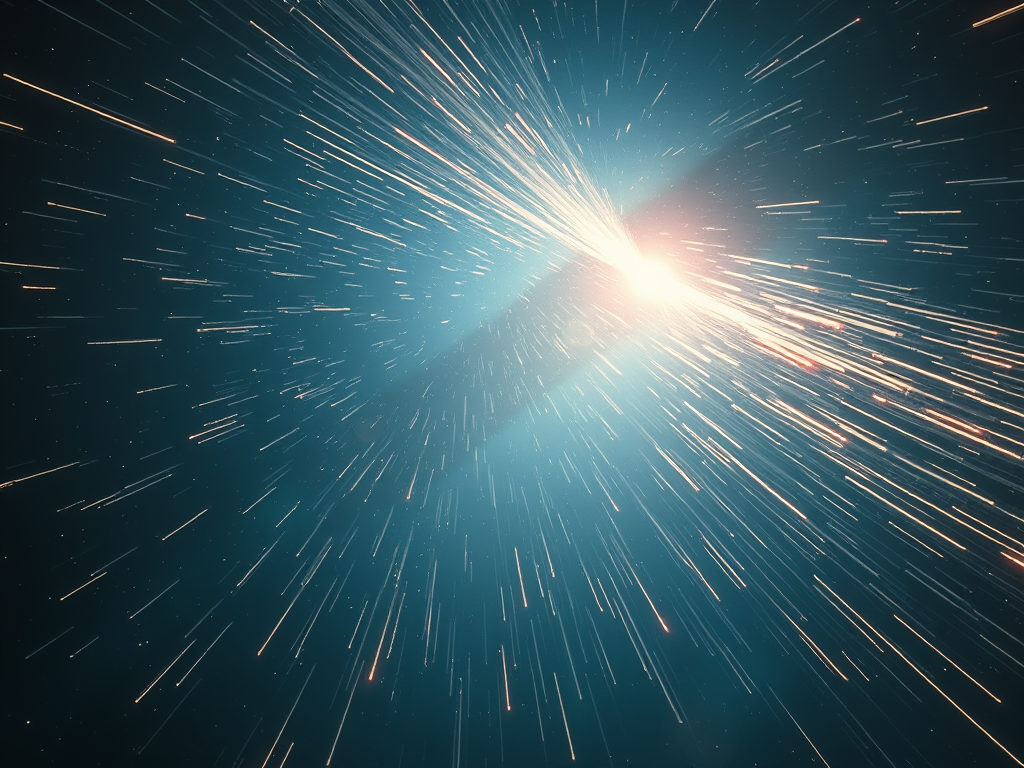
On the night of November 12, 1833, the stars began to fall.
Not metaphorically. Not in some poetic sense. They actually fell, or appeared to, by the tens of thousands, streaking across the sky in every direction, so many that people stopped counting and started praying. Some thought it was the end of the world. Others thought it was a sign from God. A few clear-headed observers realised they were witnessing something unprecedented: a meteor storm of such intensity that it would fundamentally change how we understood our place in the solar system.
They called it “the night the stars fell on Alabama”, though it was visible across the entire continent. And it would take another 33 years before anyone understood why.
This November 17-18, 2025, the Leonids return. And while we probably won’t see a storm, those are rare, once-in-a-generation events, we will see something remarkable: the debris of a comet that has been circling the Sun since before humans learned to write.
The comet you’ll never see
Here’s what you need to know about Comet Tempel-Tuttle: It’s unremarkable.
It’s a periodic comet, meaning it loops around the Sun on a predictable schedule, every 33 years, like clockwork. It’s not particularly large or bright. When it last passed through the inner solar system in 1998, you needed a telescope to see it. The next time it swings by will be 2031, and most people won’t notice.
But what Tempel-Tuttle lacks in visual drama, it makes up for in its wake. Because as it orbits, it sheds material, tiny fragments of rock and ice, most no bigger than grains of sand. These particles spread out along the comet’s orbital path, forming a debris stream that spans tens of thousands of kilometres.
Once a year, Earth passes through this stream. And when we do, those particles slam into our atmosphere at 71 kilometres per second, 160,000 miles per hour, and vaporise in a flash of light.
We call them meteors. But really, they’re tombstones. The remnants of a comet dying piece by piece across millions of years.
The pattern hidden in the sky
The 1833 meteor storm was spectacular, but it was also confusing. No one understood where the meteors came from or why they appeared to radiate from a single point in the constellation Leo.
Then, 33 years later, in 1866, the Leonids returned with another impressive display. And 33 years after that, in 1899, they returned again. The pattern was undeniable.
This is when astronomers made the connection: the meteors were linked to Comet Tempel-Tuttle, which had the same 33-year orbital period. Every time Earth passed through the densest part of the debris trail, which happened roughly once per comet cycle, we got a storm. In the years between, we got a shower: modest, predictable, and about 10-15 meteors per hour.
The math was elegant. The implications were profound. We weren’t just observers of the cosmos. We were participants, moving through space at 67,000 miles per hour, colliding with the remnants of ancient objects in a cosmic dance we were only beginning to understand.
What you’ll see (and what you won’t)
Let’s be clear: November 17-18, 2025, will not produce a meteor storm. The last one was in 2002, and the next isn’t predicted until sometime in the 2030s.
What you will see, if you’re patient and the skies are clear, is something quieter but no less remarkable: 10-20 meteors per hour, each one travelling faster than anything humans have ever built, each one tracing a path back to a point in Leo that tells you exactly where in space the debris stream is located.
The Leonids are known for two things. First, their speed. At 71 kilometres per second, they’re among the fastest meteors we encounter. That speed creates bright flashes and persistent trains, glowing trails of ionised gas that linger for seconds after the meteor itself has burned away.
Second, their fireballs. Every so often, a larger fragment, something the size of a pebble rather than a grain of sand, hits the atmosphere and produces a fireball bright enough to cast shadows. If you’re lucky, you’ll see one. If you’re very lucky, you’ll see several.
The moon that almost ruins everything
Here’s the complication for 2025: the moon.
During the peak on November 17-18, the moon will be in a waning gibbous phase, about 80% illuminated. That’s enough light to wash out the fainter meteors, reducing the number you’ll actually see.
This matters because meteor watching is a game of patience and darkness. Your eyes need 20-30 minutes to fully adapt to the night. Any source of light, streetlamps, phone screens, or the moon, resets that clock. The darker the sky, the more meteors you’ll catch.
So what do you do? You wait. You find a location as far from city lights as possible. You lie back, let your eyes adjust, and accept that you’ll see fewer meteors than you would under a new moon. But the ones you do see, fast, bright, leaving trails, will be worth it.
The song the stars inspired
That 1833 meteor storm left a mark on American culture that persists to this day. People who witnessed it told stories for the rest of their lives. It appeared in slave narratives, folk songs, and historical records.
Decades later, a songwriter named Julia Tutwiler wrote about it in a poem that eventually became the state song of Alabama: “Stars Fell on Alabama”. The phrase entered the vernacular. It became shorthand for something impossible, something miraculous, something that defied explanation.
But here’s what’s interesting: it didn’t defy explanation. Once astronomers connected the dots, the 33-year cycle, the comet, and the debris stream, it became predictable. Explainable. A natural phenomenon governed by orbital mechanics.
And yet, knowing the cause doesn’t diminish the wonder. If anything, it deepens it. Because now we understand that we’re not watching a random celestial accident. We’re watching the echo of something that happened millions of years ago, still playing out in our skies every November.
Why we still look up
There’s something primal about watching meteors.
We don’t need to. We have photographs, videos, and scientific explanations. We know what meteors are: fragments of comets and asteroids burning up in our atmosphere. We know where they come from, when they’ll appear, and how fast they’re travelling.
But knowledge doesn’t replace experience. And standing outside on a cold November night, watching a streak of light cut across the sky in a fraction of a second, connects you to something fundamental. You’re watching matter move through space at incomprehensible speeds. You’re witnessing the same process that built planets, formed atmospheres, and, if the theories are correct, delivered the water and organic compounds that made life on Earth possible.
Every meteor is a reminder that we live in a solar system that’s still evolving, still shedding debris, still rearranging itself in ways both violent and beautiful.
The storm that’s coming
The last major Leonid storm was in 2002. Observers in dark locations reported thousands of meteors per hour. The sky appeared to be falling, just as it had in 1833.
The next storm is predicted for sometime in the 2030s, when Earth passes through the densest part of Tempel-Tuttle’s debris trail again. The exact year depends on gravitational perturbations from Jupiter and Saturn, which slowly shift the debris stream over time.
When it happens, it will be spectacular. And we’ll be ready, because we’ve learned to predict these things with remarkable accuracy. We’ve mapped the comet’s orbit, modelled the debris distribution, and calculated when Earth will intersect with the thickest concentrations of particles.
But that’s years away. For now, we have the shower, the quiet, predictable version. Ten to twenty meteors per hour. Fast and bright. Radiating from Leo. A preview of the storm to come.
What November 17-18 means
The Leonids aren’t just a light show. They’re a reminder of scale.
The particles creating these meteors are millions of years old, shed by a comet that’s been orbiting the Sun since long before humans existed. They’ve travelled billions of kilometres through the vacuum of space. And now, for a brief moment, they intersect with Earth’s atmosphere and create a flash of light that lasts less than a second.
We’re watching deep time collide with the present. Ancient history written in light across the sky.
This November, find a dark place away from the city. Lie back and look up. Let your eyes adjust. Be patient. And when you see a streak of light, fast, bright, and gone before you can point it out, remember: you’re not just watching a meteor.
You’re watching a comet die, one particle at a time, across the span of millions of years.
That’s what makes the Leonids worth staying up for.