Trigonometry
-
Trigonometry – Cotangent function (cot)

The cotangent function, commonly denoted as “cot,” is a fundamental trigonometric function within the realm of geometry and mathematics. It is one of the six trigonometric functions and is defined as the reciprocal of the tangent function. In essence, the cotangent of an angle in a right triangle is equal to the ratio of the…
-
Trigonometry – Cosecant function (csc)
The cosecant function, often abbreviated as “csc,” is one of the six trigonometric functions used in geometry and mathematics. It represents the reciprocal of the sine function. Here’s a simple explanation: Definition: In a right triangle, you calculate the cosecant of an angle by dividing the length of the hypotenuse (the longest side of the…
-
Trigonometry – Secant function (sec)
-
Trigonometry – Tangent function (tan)
-
Trigonometry – Cosine function (cos)
C-A-H The cosine function of an angle is a trigonometric function that tells us about the relationship between that angle and the sides of a right triangle. It’s often written as “cos(θ),” with θ representing the angle. Here’s a simple way to understand it: Cos(θ) = (length of adjacent side) / (length of hypotenuse) When…
-
Trigonometry – Sine function (sin)
S-O-H The sine function of an angle is a trigonometric function that relates the ratio of the length of the side opposite the given angle to the length of the hypotenuse in a right triangle. It is denoted by the symbol “sin” and is used extensively in mathematics and physics to describe the relationships between…
-
Trigonometry

Trigonometry is a branch of mathematics that focuses on the relationships between the angles and sides of triangles. It’s a fundamental field of mathematics that has applications in various scientific, engineering, and practical contexts, including physics, engineering, astronomy, and more. Trigonometry is particularly useful for solving problems involving angles, distances, and the relationships between different…
-
Pythagoras’s theorem
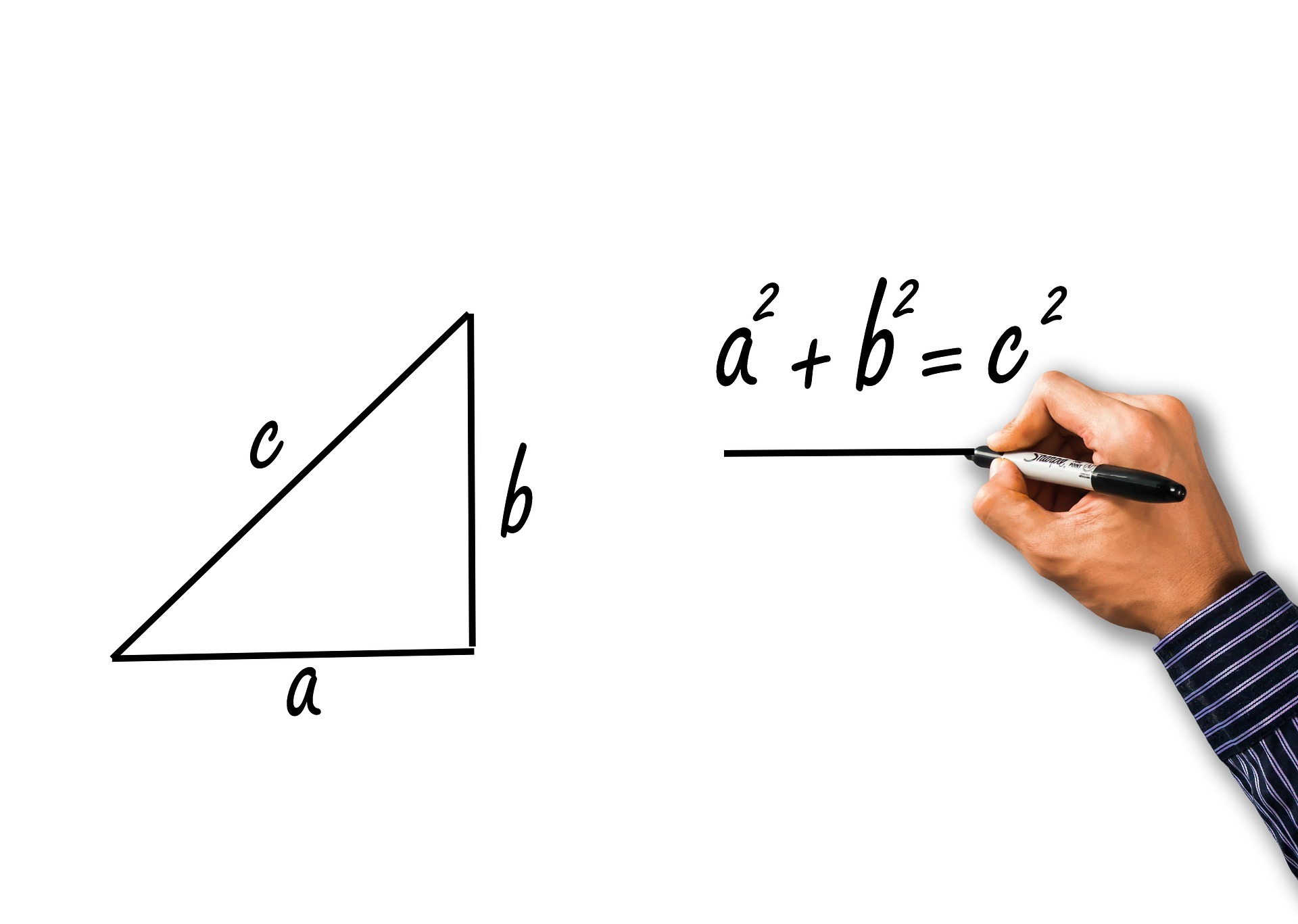
Pythagoras’s theorem is a fundamental theorem in geometry that relates to the sides of a right-angled triangle. It states that the square of the hypotenuse (the side opposite the right angle) is equal to the sum of the squares of the other two sides. In mathematical notation, it can be expressed as: a2 + b2…